

/Secondary-Role-3.png)
The government’s long-term vision for education reform
The UK Government’s schools White Paper aims to raise standards, close gaps, and ensure every child “achieves and thrives” It seeks to knit together academic standards, inclusion, attendance, behaviour, and structural reform into one long‑term roadmap.
A defining feature of the White Paper is its 10‑year timeframe, setting out reforms intended to reshape the education system by 2030 and beyond. The document outlines ambitions to halve the disadvantage gap, raise overall attainment, and establish consistent expectations around the inclusion of all pupils, setting high standards across all schools.
The proposed reforms do extend beyond curriculum and accountability measures though, also addressing workforce sustainability, with commitments aimed at improving recruitment and retention across the sector. This includes measures relating to teacher training, workload, professional development, leadership pathways, and the wider school workforce (including support staff).
The White Paper positions all of these changes as part of a longer-term programme of structural reforms, with a phased implementation over time.
Chapter 1: Our children’s futures
Chapter 1 sets out the government’s overarching ambition for childhood and young people. It describes an education and support system designed to enable children to develop academically, socially and personally, and to transition into adulthood with the knowledge, skills and confidence to participate fully in society.
The chapter situates this ambition within a wider social context, with reference to rising levels of child poverty, increasing complexity in terms of family need and the growing demand for specialist support. It recognises that improving outcomes requires co-ordinated action beyond schools alone.
A central proposal is to strengthen and formalise multi-agency working around children and families. The White Paper outlines an approach in which services are more closely aligned with education settings, with the aim of improving early identification of need, reducing fragmentation between agencies and enabling more effective sharing of information.
One significant change is the proposal for education to become to fourth statutory safeguarding partner within local multi-agency safeguarding arrangements, alongside local authorities, health and police. This formalises the role of schools and education providers within safeguarding decision-making structures and strategic planning.
Key reforms in this chapter include:
- Family Hubs to include a dedicated SEND practitioner in each hub.
- A new Inclusive Early Years Fund to support early identification and response to additional needs.
- Expansion of early education and childcare provision, including more school-based nurseries and an extension of the 30 hours government-funded childcare offer.
- An expansion of the Families First partnership programme and more in‑school Mental Health Support Teams.
- Reintroduction of a national youth strategy, with funding to increase access to safe community spaces.
- Investment to improve access to sport, particularly for under-represented groups.
The chapter also proposes a revised model of local partnership and collective accountability for all children’s outcomes. Under this approach, schools, multi-academy trusts, local authorities, Integrated Care Boards, police and other local partners would share joint responsibility for improving outcomes, with clear expectations surrounding collaboration and system-wide planning.
Chapter 2: Narrow to broad
The second chapter of Every Child Achieving and Thriving focuses on broadening the curriculum and strengthening progression from early years through to post-16 education.
The White Paper emphasises the importance of Early Years provision in laying the foundations for children’s later learning and development. It outlines increased funding to strengthen partnerships between Early Years providers and schools, with the aim of improving collaboration, professional development and continuity of support as children move into Reception. The DfE also intends to identify and share effective practice to support school readiness.
Two national targets are set:
- 75% of children to achieve a good level of development at the end of Reception by 2028
- 90% of pupils to meet the expected standard in the Year 1 Phonics Screening Check
Following the Curriculum Review, the White Paper reiterates that the national curriculum should be knowledge-rich, broad and inclusive. It highlights the use of evidence-based approaches and the need for flexibility to meet the needs of all pupils, including those with SEND.
Proposed reforms include:
- A stronger focus on digital literacy and the effective use of technology
- Introduction of a statutory reading assessment in Year 8
- Greater RISE support across regions
- A more formal place for speaking and listening across all key stages
- Assessment of writing in Year 8
- A combined secondary framework for oracy, reading and writing
- New Level 1 “preparation for GCSE” qualifications in English and maths for 16–19-year-olds who achieve grade 2 or below
The White Paper identifies transition from primary to secondary school as a key phase. It proposes:
- Reducing unnecessary repetition of primary content
- Ensuring Key Stage 3 curricula are coherently sequenced
- Maintaining breadth while building securely on prior knowledge
Chapter 2 also argues that accountability measures have become too narrowly focused. An updated version of Progress 8 is proposed, intended to recognise both core academic subjects and a broader curriculum. Pupils will be required to study two “breadth” subjects drawn from languages, creative subjects or humanities, while retaining scope for additional options.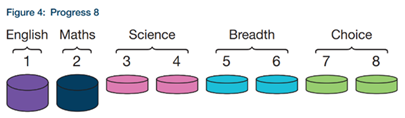
In addition, a recurring theme is the importance of enrichment as part of a holistic education. To address variation in provision, a new Enrichment Framework will set expectations that schools offer opportunities across:
- Civic engagement
- Sport and physical activity
- Art and culture
- Nature, outdoor and adventure experiences
- Essential wider life skills
Building on the Gatsby Benchmarks for careers guidance, Every Child Achieving and Thriving also sets out an expectation that all young people complete the equivalent of two weeks’ work experience during secondary education.
At post-16 level, the Department for Education is introducing new “V Levels” following the Curriculum Review. These are positioned as a vocational pathway alongside existing academic and technical routes. The White Paper also outlines work to strengthen transitions between secondary school and further education, with the aim of improving clarity and continuity in progression pathways.
Chapter 3: Sidelined to included
Chapter 3 focuses on reforming the system of support for children and young people with special educational needs and disabilities (SEND). It sets out proposals intended to strengthen inclusion within mainstream education while improving consistency, clarity and early intervention.
A central theme is the creation of a clearer, layered model of support. The White Paper outlines:
- A strengthened Universal Offer, clarifying expectations of mainstream provision
- A new three-tier model of support
- The introduction of Individual Support Plans (ISPs) for pupils with additional needs that do not require an Education, Health and Care Plan
- Updates to the SEND Code of Practice
- A clearer and more strategic role for the SENCo
- Development of Inclusion Bases within mainstream settings
- Access to specialist expertise through an “Experts at Hand” approach
- Reform of Alternative Provision
- Revised approaches to SEND funding and accountability
The chapter positions inclusion as a system-wide responsibility, with the aim of reducing fragmentation, improving early identification of need and ensuring that more pupils can be successfully supported within mainstream education.
For a more detailed breakdown of these proposals, including analysis of implementation and implications for schools and trusts, see our blog: ‘The Schools White Paper explained (part 1): SEND, EHCP reform and inclusion’
Chapter 4: Withdrawn to engaging
This section of the White Paper focuses on pupil engagement, attendance and the wider relationship between schools, families and communities. It addresses the rising levels of elective home education, increased suspensions and exclusions, and persistent absence.
Pupil engagement and belonging:
- By 2029, all schools will be expected to monitor pupils’ sense of belonging and engagement. In addition to an annual report on pupil experiences, a new Pupil Engagement Framework is due to be published to provide structure and guidance in this area.
- The government’s Race Equality Unit will also undertake further research into racist abuse in schools, contributing to the evidence base on pupil experience and inclusion.
Home–school partnerships and communication:
- Clearer national expectations for home–school partnerships. This includes setting out what families can expect from schools and what schools can expect from families. Guidance and support will be made available to help parents support learning at home.
- In relation to complaints, the government intends to introduce a clearer and more accessible system, including a new digital solution and definedexpectations for how complaints are handled.
- A new national school profile will also be developed, designed to provide parents with up-to-date information about schools in a single, accessible format.
Attendance:
Improving attendance is a central element. The government has set a target to raise overall attendance by 1.3 percentage points to above 94%. Planned measures include:
- Expansion of RISE attendance and behaviour hubs
- Deployment of specialist attendance advisers to support and challenge local authorities
- Routine assessment for Family Help through the Families First Partnership for severely absent pupils without a social worker
- Expansion of the attendance mentoring programme to support an additional 10,000 persistently absent pupils
Other proposed measures include improvements to access to same-day digital and telephone health consultations, alongside work with schools to better support pupils with health conditions. A new duty will require councils to notify schools, health visitors and GPs when a child is placed in temporary accommodation.
Behaviour and inclusion:
- The provision of further practical guidance on reasonable adjustments and to strengthen outreach partnerships between alternative provision, special schools and mainstream settings. Schools will be encouraged to review reward and recognition systems alongside behaviour policies.
- In relation to suspensions and exclusions, the White Paper proposes maintaining flexibility for schools to suspend pupils, while recognising sanctions may need to be completed on site. It is also considering a duty for schools to set work for suspended or excluded pupils.
Transitions and pupil movement:
- The government intends to strengthen oversight of pupil movement between schools, with the aim of improving transparency and reducing unlawful ‘off-rolling’.
- A new dashboard will identify school-level trends in pupil movement across the system.
Chapter 5: Support and investment in high-quality staff
Chapter 5 focuses on workforce capacity and leadership, setting out measures intended to support the recruitment, retention and development of teachers, leaders and support staff.
The government has stated an ambition to recruit 6,500 additional teachers. To support this, it outlines a three-part workforce strategy:
- Attract: widening and promoting routes into teaching
- Retain: improving working conditions and day-to-day experience
- Develop: strengthening career-long professional development
The White Paper also confirms continued reform of statutory pay and conditions, including the intention to remove the current pay ceiling for teachers and leaders.
A new teacher retention programme is due to launch in Autumn 2026. Measures outlined in the chapter include:
Chapter 5 also identifies leadership as a key driver of school improvement. Proposed measures include:
- A review of barriers affecting school and trust leaders
- Targeted Excellence in Leadership interventions
- Leadership training and ongoing support aligned to current sector challenges
In addition, reference is made to longer-term maintenance funding settlements for schools and colleges, intended to support greater financial stability and longer-term planning.
Chapter 6: Collaboration between schools and with other partners
Chapter 6 centres on system-wide collaboration and sets out the government’s intention to move towards a fully trust-based school system. The White Paper states that all schools will be expected to join or form a high-quality multi-academy trust, with the pace of transition shaped by local context rather than fixed national deadlines.
The government positions trusts as vehicles for sustained collaboration, shared governance and collective accountability. To support this shift, new trusts will be permitted to be established by local authorities and local partnerships, with safeguards in place to manage conflicts of interest and clarify the distinction between strategic oversight and operational control.
To strengthen expectations of quality and consistency, the White Paper introduces:
- New Trust Standards, setting out requirements relating to educational performance, inclusion, governance, financial management and community engagement
- A programme of trust-level inspections, focused on evaluating overall impact and effectiveness
- The chapter also outlines strengthened intervention powers, including the ability to move schools from underperforming trusts into stronger ones where necessary.
Local authorities retain a central role within the evolving system. Their responsibilities continue to include safeguarding, SEND provision, admissions, place planning and support for vulnerable children. The White Paper highlights the need for clear partnership arrangements between trusts and local authorities, particularly as additional duties under forthcoming legislation increase oversight of children not in school and support for specific groups such as those in kinship care.
The White Paper also commits to improving transparency in how trusts pool and deploy funding. This includes clearer expectations around executive pay, with requirements that remuneration is proportionate and publicly justified.
Chapter 7: Enabling innovation and ambition
‘Enabling Innovation and Ambition’ focuses on creating the conditions for continuous improvement across the education system. The White Paper describes the government’s ambition to develop a self-improving system in which effective practice is identified, shared and scaled.
A key mechanism for this is the expansion of the RISE programme, which is intended to support schools in identifying priorities and implementing improvement strategies. Alongside this, a new digital platform will be introduced to help schools assess their strengths and areas for development, benchmark themselves against similar institutions and access targeted support. Comparable benchmarking approaches are already in place in areas such as attendance.
The government will work in partnership with the Education Endowment Foundation to increase access to research and evidence-informed practice for teachers and leaders. In addition, enhanced RISE programmes will focus on national priorities including attainment, inclusion, Reception year outcomes and attendance.
The White Paper recognises the growing role of digital tools within education. It sets out expectations that any Artificial Intelligence tools used in schools must meet established standards for safety, quality and safeguarding. Trials of AI tutoring tools for secondary pupils are planned, alongside continued investment in assistive technology to support pupils with SEND.
To support improvement planning, the government proposes the development of a new “data spine” for education. This infrastructure is intended to enable more effective connection and sharing of information across systems, supporting analysis, benchmarking and strategic decision-making.
Chapter 8: Implementation, funding and delivery
The final chapter sets out how the government intends to implement its reforms, emphasising phased delivery, sustained investment and partnership working across schools, trusts, local authorities and wider services.
The implementation approach recognises that some reforms introduce new expectations, while others refine existing policy. Schools will be expected to adapt to changes such as curriculum reform and revised SEND arrangements, with collaboration between schools and trusts positioned as a key mechanism for shared expertise and system-wide improvement.
The chapter outlines significant financial commitments to support delivery. The core schools budget is set to increase to £67 billion by 2026–27. Alongside this, targeted investment will support inclusion and SEND, including:
- The Inclusive Mainstream Fund
- The Experts at Hand programme
- Expanded training and workforce development funding
- A substantial capital investment programme
Funding reform also includes the move to a direct National Funding Formula, intended to ensure that mainstream schools are funded through a consistent national approach rather than multiple local formulae.
Support mechanisms extend beyond funding. Through the RISE service and sector-led collaboration, schools will have access to improvement tools, guidance and examples of effective practice.
The government also commits to simplifying guidance, including:
- Creating a single, centralised home for school guidance
- Streamlining and clarifying documentation
- Introducing AI-enabled tools to support navigation and access
Several reforms are linked to contributing to workload reduction over time, including clearer behaviour guidance, improved complaints processes and measures to support more efficient resource use.
The implementation plan spans multiple academic years and is structured in three overlapping phases:
- 2025/26: alignment with identified best practice and higher standards
- 2026/27: preparation for major curriculum and SEND reforms
- 2028/29: onwards: full reform implementation
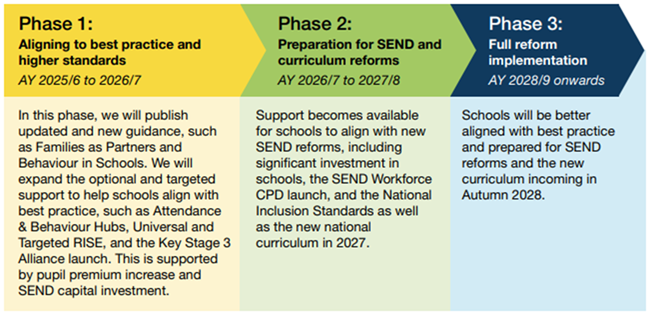 The government states that major reforms, particularly in complex areas such as SEND, will involve continued consultation and, where appropriate, piloting before full rollout. The intention is to provide schools and families with clarity around sequencing and sufficient lead-in time for planning and adaptation.
Conclusion
In summary, Every Child Achieving and Thriving sets out a wide-ranging programme of reform – combining long-term ambition with detailed proposals across curriculum, inclusion, workforce, accountability and system structure. It acknowledges the complexity of the current education landscape and outlines changes intended to align standards, support mechanisms and governance arrangements.
Throughout, inclusion and high standards are positioned as complementary priorities. The reforms span early years through to post-16 education, and extend beyond schools to encompass partnerships with families, local authorities, trusts and wider public services.
Delivery will depend on subsequent legislation, funding settlements, implementation timelines and continued engagement with the sector. Reforms are intended to be phased over several academic years, with consultation and piloting in key areas.
Don't forget to share this post!
